
Why Amazon bought Bee, an AI wearable
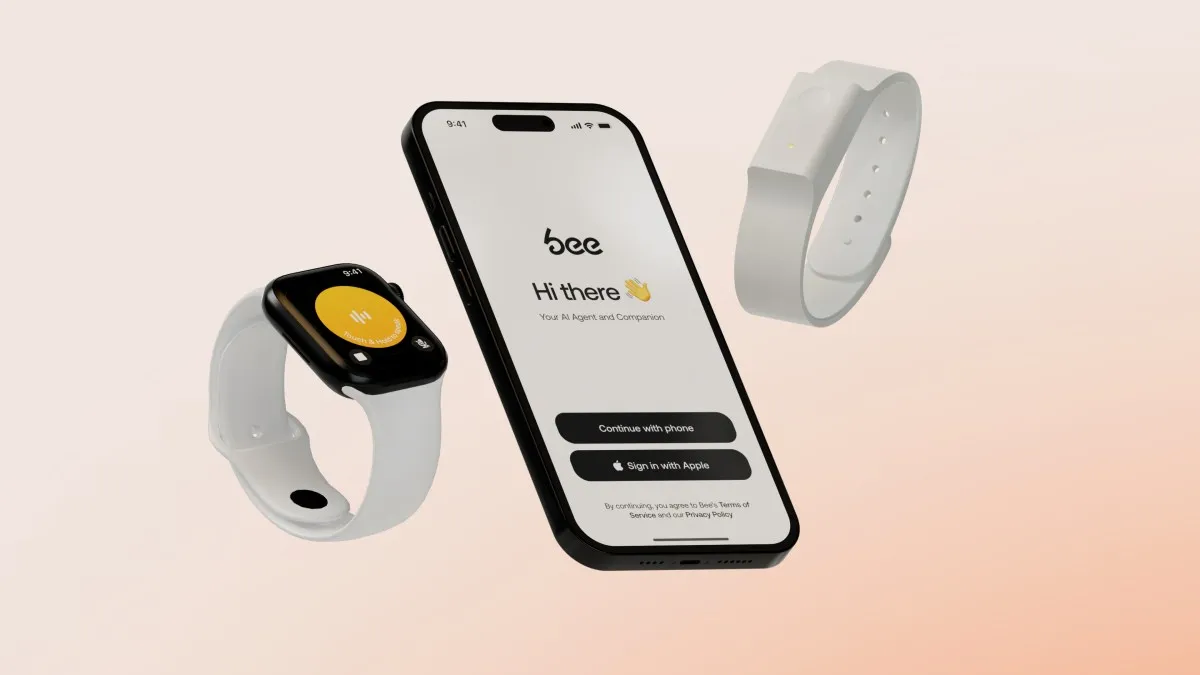
Amazon explains where its wearable Bee fits in and whether it will merge with Alexa.
Smart rings, smart screens, smart TVs, smart pins, smart … ice cube makers? Sure, why not! AI was everywhere at this year’s Consumer Electronics Show (CES) in Las Vegas, where companies large and small were showing off how they’re bringing AI to more devices. For Amazon, CES was a time to show off its newest acquisition in the space: Bee, an AI device that can be worn as a clip-on pin or a bracelet.
Amazon already has an entry in the AI consumer devices space with Alexa, whose upgraded AI-powered version, Alexa+, can run on 97% of the hardware devices Amazon has shipped. However, with Bee, the company is gaining access to a wearable that could extend its reach outside the home.
Largely designed for recording conversations like interviews, meetings, or classes, Bee also works as an AI companion. The AI has access to world knowledge, and it learns more about you from a combination of your recordings and the services you permit it to access like Gmail, Google Calendar, your phone’s contacts, and Apple Health.
Given that Amazon has already tried integrating Alexa into wearables like earbuds and glasses, it could seem like the company is muddying the waters with the addition of another AI companion. However, those earlier Alexa devices have not taken off in the face of competition like Apple’s AirPods and Ray-Ban Meta AI glasses. Amazon seems to understand this, which is why it’s adding Bee to its lineup.
“We see each other as complementary friends,” says Bee co-founder Maria de Lourdes Zollo of Bee’s relationship with Alexa, in an interview at CES last week. “Bee has the understanding of outside the house, and Alexa has the understanding of inside the house. Of course, there will be a future where these two things come together.”
That future doesn’t yet mean Bee’s AI will be replaced by Alexa. Noted Amazon Alexa VP Daniel Rausch, Amazon thinks what the team at Bee created is an “important and lovable experience.” He describes Bee as a “deeply engaging and personal” AI, but he also agreed that, at some point, Alexa and Bee would come together.
“We know that it will create even more benefit for customers than what [the AI experiences] do on their own,” Rausch explained. “When you have access to the power of these AI experiences with you throughout the day, and they’re continuous — we’re gonna be able to do so much more for customers.”
De Lourdes Zollo said that Bee learns from its users, gaining an understanding of their patterns, insights, and commitments, which can help it to suggest to-do items and follow-ups throughout your day.
Early use cases have included students who record lectures, elderly people who have trouble remembering things, and people who speak for a living and don’t want to always take notes manually.
“They just want a place to have all the summarization of everything they said,” Bee’s co-founder said. “So based on that, we build a really big graph of knowledge [about] you, where you can go chat with Bee, and have an understanding of what happened to you, but also how you’re changing during the course of your life,” de Lourdes Zollo added.
Similar to Alexa, Bee uses a combination of AI models under the hood, but it’s exploring adding Amazon’s AI as one in the mix. After transcribing the conversation, Bee discards the audio, making it impractical for many work-related use cases where you need to play back the conversation to ensure accuracy.
There’s still much ahead for Bee in 2026, de Lourdes Zollo teased, without giving anything away. In addition to recent announcements of new features and functionality — like voice notes, templates, daily insights, and more — the founder said the eight-person team is working on “many new things” out of their HQ in San Francisco, where Amazon already has a large number of hardware and Alexa employees.
“Honestly, it’s endless possibilities now, and that’s one of the reasons why we’re really excited to be part of Amazon,” she said.
More Articles

AI Tools for Productivity Without Workflow Chaos
This article helps technology leaders, creators, and curious professionals explore AI tools through the lens of personal productivity. It explains how to select tools that reduce repetitive work without creating new overhead, with practical priorities that support clearer decisions and more dependable results.

How to Build an AI Application Around a Real User Need
This article helps technology leaders, creators, and curious professionals explore AI application through the lens of product development. It explains how to move from problem definition through prototyping, evaluation, and launch, with practical priorities that support clearer decisions and more dependable results.

AI Agents in Business: Where Autonomy Helps and Hurts
This article helps technology leaders, creators, and curious professionals explore AI agents through the lens of business automation. It explains how to assign bounded tasks while preserving approval, visibility, and accountability, with practical priorities that support clearer decisions and more dependable results.

Responsible AI Adoption: A Practical Governance Framework
This article helps technology leaders, creators, and curious professionals explore responsible AI through the lens of AI governance. It explains how to manage privacy, bias, security, transparency, and human oversight, with practical priorities that support clearer decisions and more dependable results.

How to Choose AI Software for Your Organization
This article helps technology leaders, creators, and curious professionals explore AI software through the lens of software selection. It explains how to compare usefulness, integration, reliability, cost, and vendor risk, with practical priorities that support clearer decisions and more dependable results.

AI in the Workplace: Redesign Tasks, Not Just Job Titles
This article helps technology leaders, creators, and curious professionals explore AI in the workplace through the lens of work transformation. It explains how to combine automation with judgment, training, and better operating processes, with practical priorities that support clearer decisions and more dependable results.

Computer Vision Applications Beyond Image Recognition
This article helps technology leaders, creators, and curious professionals explore computer vision applications through the lens of visual intelligence. It explains how to apply detection, inspection, measurement, tracking, and visual search, with practical priorities that support clearer decisions and more dependable results.

AI Model Performance: Measure What Actually Matters
This article helps technology leaders, creators, and curious professionals explore AI model performance through the lens of model evaluation. It explains how to test quality, latency, cost, safety, drift, and business impact, with practical priorities that support clearer decisions and more dependable results.