
Meta pauses teen access to AI characters ahead of new version
Meta today said that it is pausing teens' access to its AI characters globally across all its apps. The company mentioned that it is not abandoning its efforts but wants to develop an updated version of AI characters for teens.
Meta today said that it is pausing teens’ access to its AI characters globally across all its apps. The company mentioned that it is not abandoning its efforts but wants to develop an updated version of AI characters for teens, the company exclusively told TechCrunch.
The move comes days before a case against Meta is set to go to trial in New Mexico, in which the company is accused of not making an effort to protect kids from sexual exploitation on its apps. Wired reported Thursday that Meta has sought to limit discovery related to social media’s impact on teen mental health.
In October, the company previewed parental controls for AI characters, allowing parents and guardians to monitor topics and block access to certain characters. Meta said parents would be able to completely turn off chats with AI characters. These features were set to release this year, but the company is now turning off AI characters altogether for teens while it updates the AI characters to a newer version.
Meta said that it heard from parents that they wanted more insights and control over their teens’ interactions with AI characters, which is why it decided to make these changes.
The company has been cracking down on teens’ access to AI content in its apps. Also in October, Meta rolled out parental control features on Instagram, focusing on tailoring the teen experience of interacting with AI on its apps. These features, which were inspired by the PG-13 movie rating, restricted teen access to certain topics like extreme violence, nudity, and graphic drug use.
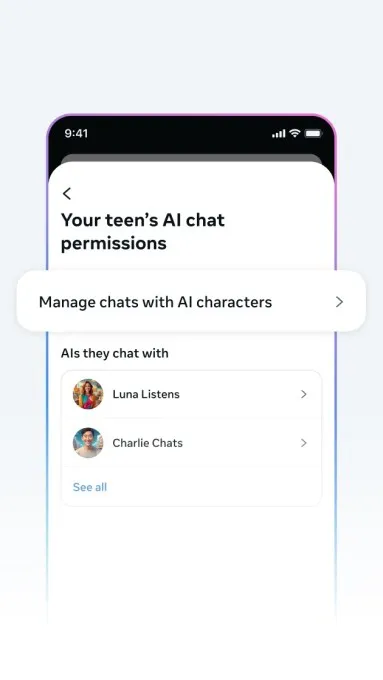
“Starting in the coming weeks, teens will no longer be able to access AI characters across our apps until the updated experience is ready. This will apply to anyone who has given us a teen birthday, as well as people who claim to be adults but who we suspect are teens based on our age prediction technology,” the company said in an updated blog post.
Meta added that when it rolls out the new AI characters, they will have built-in parental controls. The company said that the new characters will give age-appropriate responses and will stick to topics like education, sport, and hobbies.
Social media companies are under heavy scrutiny from regulators. Apart from the aforementioned case in New Mexico, Meta is also facing a trial next week, where the platform is accused of causing social media addiction. CEO Mark Zuckerberg is expected to take the witness stand in that case once the trial begins.
Besides social platforms, AI companies have had to modify their experience for teens after facing lawsuits alleging to play a part in aiding self-harm. In October, Character.AI, the startup that allows users to chat with various AI avatars, disallowed open-ended conversations with chatbots for users who were under 18. In November, the startup said it would build interactive stories for kids. In the last few months, OpenAI added new teen safety rules for ChatGPT and started predicting a user’s age to apply content restrictions.
Correction: This post was updated to clarify the new version of AI characters will be accessible to everyone, not just teens, when it launches. It will include parental controls.
More Articles

AI Tools for Productivity Without Workflow Chaos
This article helps technology leaders, creators, and curious professionals explore AI tools through the lens of personal productivity. It explains how to select tools that reduce repetitive work without creating new overhead, with practical priorities that support clearer decisions and more dependable results.

How to Build an AI Application Around a Real User Need
This article helps technology leaders, creators, and curious professionals explore AI application through the lens of product development. It explains how to move from problem definition through prototyping, evaluation, and launch, with practical priorities that support clearer decisions and more dependable results.

AI Agents in Business: Where Autonomy Helps and Hurts
This article helps technology leaders, creators, and curious professionals explore AI agents through the lens of business automation. It explains how to assign bounded tasks while preserving approval, visibility, and accountability, with practical priorities that support clearer decisions and more dependable results.

Responsible AI Adoption: A Practical Governance Framework
This article helps technology leaders, creators, and curious professionals explore responsible AI through the lens of AI governance. It explains how to manage privacy, bias, security, transparency, and human oversight, with practical priorities that support clearer decisions and more dependable results.

How to Choose AI Software for Your Organization
This article helps technology leaders, creators, and curious professionals explore AI software through the lens of software selection. It explains how to compare usefulness, integration, reliability, cost, and vendor risk, with practical priorities that support clearer decisions and more dependable results.

AI in the Workplace: Redesign Tasks, Not Just Job Titles
This article helps technology leaders, creators, and curious professionals explore AI in the workplace through the lens of work transformation. It explains how to combine automation with judgment, training, and better operating processes, with practical priorities that support clearer decisions and more dependable results.

Computer Vision Applications Beyond Image Recognition
This article helps technology leaders, creators, and curious professionals explore computer vision applications through the lens of visual intelligence. It explains how to apply detection, inspection, measurement, tracking, and visual search, with practical priorities that support clearer decisions and more dependable results.

AI Model Performance: Measure What Actually Matters
This article helps technology leaders, creators, and curious professionals explore AI model performance through the lens of model evaluation. It explains how to test quality, latency, cost, safety, drift, and business impact, with practical priorities that support clearer decisions and more dependable results.