
About 12% of US teens turn to AI for emotional support or advice

General-purpose tools like ChatGPT, Claude, and Grok are not designed for this use, making mental health professionals wary.
AI chatbots have become embedded in the lives of American teenagers, according to a report published Tuesday by the Pew Research Center.
While the most common uses of AI among this demographic include searching for information (57%) and getting help with schoolwork (54%), teens are also using AI to fill roles that would typically be occupied by friends or family. Sixteen percent of U.S. teens say they use AI for casual conversation, while 12% use AI chatbots for emotional support or advice.
Some teens may find solace in talking to chatbots, but mental health professionals are wary. General-purpose tools like ChatGPT, Claude, and Grok are not designed for such uses, and in the most extreme cases, these chatbots can have life-threatening psychological effects.
“We are social creatures, and there’s certainly a challenge that these systems can be isolating,” Dr. Nick Haber, a Stanford professor researching the therapeutic potential of LLMs, told TechCrunch recently. “There are a lot of instances where people can engage with these tools and then can become not grounded to the outside world of facts, and not grounded in connection to the interpersonal, which can lead to pretty isolating — if not worse — effects.”
Pew’s survey also shows a discrepancy between teenagers’ self-reported AI usage and the extent to which their parents think they engage with this technology. About 51% of parents said that their teen uses chatbots, while 64% of teens reported using them.
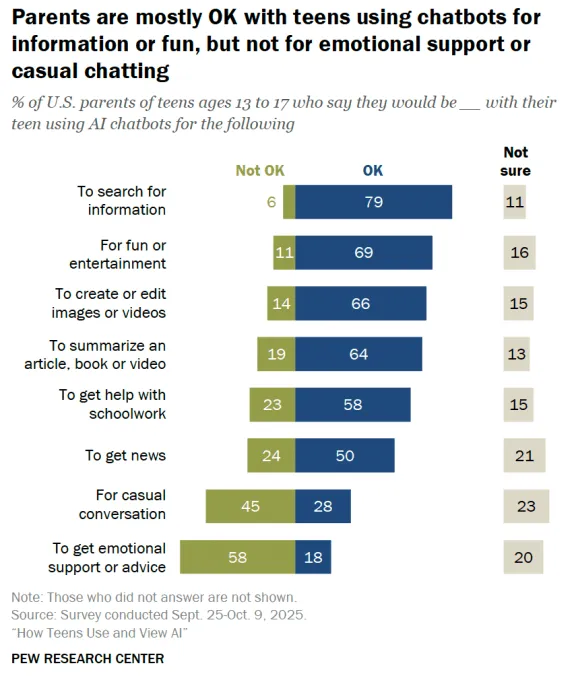
The majority of parents are okay with their teens using AI to search for information (79%) or get help with schoolwork (58%), but far fewer parents approve of their teens using AI chatbots for casual conversation (28%) or to get emotional support or advice (18%). In fact, 58% of parents are not okay with their child using AI for such purposes.
AI safety is a contentious topic among leading tech companies, to say the least. But one popular chatbot maker, Character.AI, made the choice to disable the chatbot experience for users under the age of 18. This decision followed public outcry and lawsuits filed over two teenagers’ suicides, which took place after prolonged conversations with the company’s chatbots. OpenAI, meanwhile, made the decision to sunset its particularly sycophantic GPT-4o model, which sparked backlash from people who had come to rely on the model for emotional support.
Though a majority of teens use AI chatbots in some way, they have mixed feelings about the impact of this kind of technology on society. When asked how they think AI will impact society over the next 20 years, 31% of teens said the impact would be positive, while 26% said it would be negative.
More Articles

AI Tools for Productivity Without Workflow Chaos
This article helps technology leaders, creators, and curious professionals explore AI tools through the lens of personal productivity. It explains how to select tools that reduce repetitive work without creating new overhead, with practical priorities that support clearer decisions and more dependable results.

How to Build an AI Application Around a Real User Need
This article helps technology leaders, creators, and curious professionals explore AI application through the lens of product development. It explains how to move from problem definition through prototyping, evaluation, and launch, with practical priorities that support clearer decisions and more dependable results.

AI Agents in Business: Where Autonomy Helps and Hurts
This article helps technology leaders, creators, and curious professionals explore AI agents through the lens of business automation. It explains how to assign bounded tasks while preserving approval, visibility, and accountability, with practical priorities that support clearer decisions and more dependable results.

Responsible AI Adoption: A Practical Governance Framework
This article helps technology leaders, creators, and curious professionals explore responsible AI through the lens of AI governance. It explains how to manage privacy, bias, security, transparency, and human oversight, with practical priorities that support clearer decisions and more dependable results.

How to Choose AI Software for Your Organization
This article helps technology leaders, creators, and curious professionals explore AI software through the lens of software selection. It explains how to compare usefulness, integration, reliability, cost, and vendor risk, with practical priorities that support clearer decisions and more dependable results.

AI in the Workplace: Redesign Tasks, Not Just Job Titles
This article helps technology leaders, creators, and curious professionals explore AI in the workplace through the lens of work transformation. It explains how to combine automation with judgment, training, and better operating processes, with practical priorities that support clearer decisions and more dependable results.

Computer Vision Applications Beyond Image Recognition
This article helps technology leaders, creators, and curious professionals explore computer vision applications through the lens of visual intelligence. It explains how to apply detection, inspection, measurement, tracking, and visual search, with practical priorities that support clearer decisions and more dependable results.

AI Model Performance: Measure What Actually Matters
This article helps technology leaders, creators, and curious professionals explore AI model performance through the lens of model evaluation. It explains how to test quality, latency, cost, safety, drift, and business impact, with practical priorities that support clearer decisions and more dependable results.